
Your company already pays for AI. Now find out what it gives back.
At the end of the day, you need to know where money comes into your business and where it goes out. AI is no different. We show, in numbers, what each agent produces, what it costs, what risk it carries and who answers for it.
In
- Hours given back to the team?
- Decisions made sooner?
- Errors caught before they cost?
Out
- Platform and licenses?
- Model and agent usage?
- Hours of human review?
- Risk of an act with no owner?
The AI numbers still don’t add up
- 56%
of CEOs say AI has brought neither more revenue nor lower costs yet.1
- 9in 10
expect measurable returns from AI agents in 2026.2
- 85%
of large companies have agents acting without real-time human oversight.3
- 31%
saw significant value when AI aimed at better decisions. With a productivity-only focus, it was 17%.4
Where AI touches the bottom line
Is the team delivering more with AI, and deciding sooner?
A person approves the work plan once, with clear limits. In a data load with a hundred commands, that is one human decision, not a hundred.
100agent commands
1plan approval
How much did AI cost this month, and who authorized it?
Each agent works under a spending ceiling per period. Cost closes per piece of work, tied to the decision it serves.
Period ceiling, approved by the accountable owner
What if an agent gets it wrong?
Every act has a shape, and the shape says how much human attention it needs. Nobody approves their own work.
- QueryReads and answers. Changes nothing.
- Reviewable writeExecutes, and a person reviews afterwards.
- Proposal with approvalOnly happens once approved.
Who answers for this?
Each agent has an owner who accepted, by name, the limit of what it may do. Every week the owner gets a summary.
- Usage
- What each agent did
- Cost
- What it spent, against the ceiling
- Impact
- Which decision the work fed
- Risk
- What needed review, and what changed
We don’t promise gains before measuring. Your company does the measuring.
Every platform does its part well. The hub organizes the work across all of them.
Data platforms, AI clouds, business systems and agent vendors already bring their own capabilities, including agents. EDAVEN competes with none of them: it sits above, as the hub that places people and agents from all of them on one map of responsibility.
Organization
EDAVEN Organization & Agents
- People and teams
- Agents of any origin, allocated to teams
- Owner and limit for each agent
- Approvals and receipts
- Cost per piece of work
- Company memory
Agent control plane
Every act within the accepted limit
- Agent identity
- Shape and limit of each act
- Review by another person
- Record of every act
Platforms and systems
Where the work already happens
- Data platformswarehouse, lakehouse, catalog
- AI clouds and servicesmodels and agents
- Business systemsERP, CRM, service
- Analytics and BIdashboards and reports
- Vendor agentsthird-party assistants
- Work toolswhere people work
And the ones the company already uses, from any vendor.
What each platform does
- Does its own job: stores and governs data, runs models, executes processes.
- Offers its own agents and assistants.
- Controls access to what is its own.
What the hub adds
- Allocates agents of any origin to teams: ours, plug-ins, and those from other platforms and vendors.
- Puts people and agents from every platform on one map.
- Gives each agent an owner and a limit accepted by name.
- Routes what carries risk to another person and keeps a receipt of every act.
- Closes cost per piece of work and ties the work to the decision it serves.
With EDAVEN, the company keeps using each platform’s native capabilities, including its agents. Arcogi is a Registered partner in the Snowflake Partner Network.
The hub creates, allocates and governs agents
We design and build specialist agents for your business that run as plug-ins where people work, in your environment or on the data platform. The hub already comes with plug-in agents for Data Ready and Decision Intelligence operations, and with the EDAVEN Builder Agent to create your own. It also takes in agents from other platforms and vendors and allocates them to teams. Control stays in one place.
Registered installation
Each plug-in has a known owner, version and place where it runs.
Every act goes through the hub
The agent acts within the accepted limit, and every act leaves a receipt.
Revoke switches it off
Revoke the agent or let the limit expire, and it stops acting everywhere.
No self-certification
If the vendor changes the agent, it goes back through qualification before getting work.
The agent is built with the business specialist, from an industry template. A person reviews and signs it before any use.
See the agent architectureEvery agent is born governed.
AI and agent governance is not a separate project, nor a policy document. It is part of each agent’s architecture, engineering and operation from day one, and every rule is applied to every act while the agent works.
Gartner expects more than 40% of agent projects to be canceled by 2027 because of cost, unclear value and gaps in risk management. Gartner, Hype Cycle for Artificial Intelligence, 2026
In the architecture
Policies and risk
- An inventory of agents, models and third-party AI
- Risk classified per case, with the control it requires
- Purpose, owner, team and a limit accepted by name
- Only data with defined origin, purpose and retention
- Only models approved for that type of data
In the engineering
Security and quality
- Its own identity and mandate for each agent
- Actions outside the mandate denied before they run
- Adversarial and bias tests, and tests for the known risks of agent applications
- Vendor agents qualified on entry and again when they change
- A person reviews and signs each version before use
In the operation
Oversight and audit
- Another person reviews what carries risk; dual approval for high risk
- A stop condition and who authorizes resuming
- Monitoring of drift, exceptions and consumption, with a cost ceiling
- Incidents handled with an evidence package
- A receipt and provenance for every act; autonomy that rises and falls with the track record
And the learning stays with the company: human-curated memory, in your environment, outside the vendor’s model.
Controls are linked to the frameworks auditors and customers ask for: the EU AI Act, GDPR, ISO/IEC 42001, the NIST AI RMF and OWASP for LLMs and agents. This is a reference mapping, not legal advice or certification. See governance in detail
Same agent, same platform, two ways of working
In a fictional retail chain, with synthetic data, an AI agent loaded the full sales history into Snowflake. Snowflake did its part both times. What changed was how the work was organized.
- 152tables
- 4.48 Mrows
- 170+commands
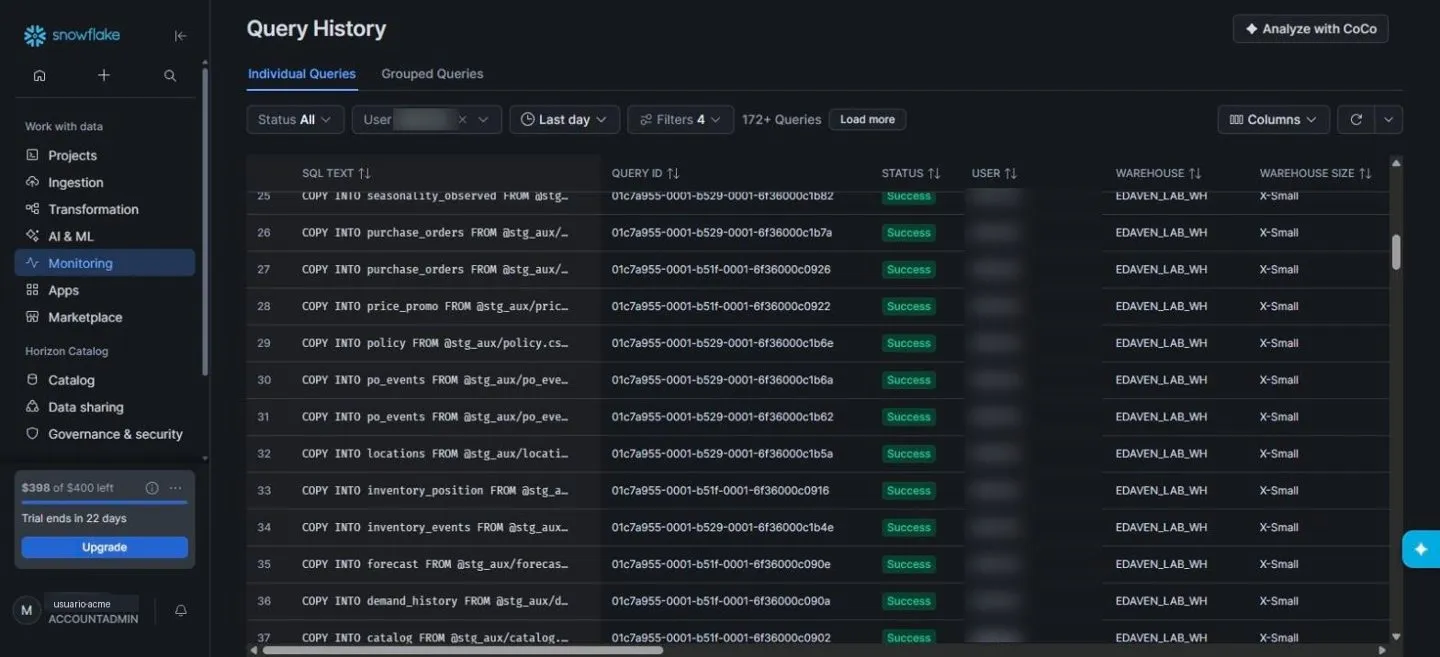
- The work was authorized in a chat, with the broadest access in the account.
- The cost of the agent and of the people showed up nowhere.
- The proof that the result matched sat in a file outside the company record.
- The request was logged, with an owner, a goal and a deadline.
- The agent got a limit accepted by name, only for the duration of the run.
- The engineer approved the plan once, with a cost ceiling.
- Every step left a receipt, and the proof went into the company record.
How we start
The first step is the Organization & Agents hub: giving an owner, a limit and proof to what already runs. Decisions come later, once the base is ready.
Map
We survey the agents and AI uses the company already has, on any platform, and who answers for each one.
Organization & Agents
Organize
People and agents go on the same map. Each agent gets an owner, a team and a limit accepted by name.
Organization & Agents
Govern the operation
What carries risk goes to another person. Every act leaves a receipt, and every piece of work has a cost ceiling.
Organization & Agents
Connect to decisions
With the base in place, the agents’ work starts serving business decisions, with an owner and a tracked effect.
Decisions
Each stage ends with your decision: continue, correct, expand or stop.
See how to engageIndustry cookbooks
On the systems your company already has
On the platforms, clouds and systems the company already uses, with each one’s native capabilities. Arcogi is a Registered partner in the Snowflake Partner Network.
Bring a decision that weighs on results.
In half an hour, Matias will tell you where we can help, or that it is better to wait.
We don’t charge by outcome or promise gains before measuring.Sources
- PwC, 29th Global CEO Survey, January 2026, 4,454 CEOs in 95 countries.
- BCG, AI Radar 2026, January 2026, 2,360 executives, 640 of them CEOs.
- EY, AI Risk and Governance Survey, September 2026, 202 executives at US companies with revenue above one billion dollars.
- Gartner, survey of finance leaders, via CFO Dive, July 2026, more than 200 respondents.