
LabAcme · synthetic retail · data engineering
Authority before the act
Agents with authority, not just access. The same Snowflake load, without and with EDAVEN: authority, responsibility and control on every act.
What separates those who scale
AI agents already deliver. Models are excellent and ever cheaper. What separates those who scale from those stuck in tests are three answers the organisation needs before every act.
Snowflake did its part both times. Both loads used the same native platform capabilities and reached the same result. The difference lies in how the work was organised: who authorised it, within what limit, who reviewed it and where the proof was kept. That is what the EDAVEN hub adds, above the platform and without replacing it.
Authority
Who authorised the agent, with what reach and until when.
Responsibility
Who answers for the act, with a name, a receipt and proof of the data it used.
Control
What the machine decides alone and where a person steps in, written down and applied.
The question people usually ask is a good one: if the agent gets it wrong tomorrow, can we trace the data it used, who owns it and who answers?
But it still looks backwards. The operating question is different:
Today, does every agent act with delegated authority, with an owner who accepted the mandate and within the limits someone wrote down?
When the answer is yes, the organisation delegates more, with confidence. Getting there takes more than a design: it takes an operation. Architecture says where the controls sit. Engineering turns the rule into a control applied to every act. Operation does it every day, with owner, evidence and cost. To show the difference, we did a common data engineering job both ways.
The lab
Acme is a synthetic retail organisation we use to operate EDAVEN as if it were a real operation. It has a DW with sales, inventory, customers and items from 2024 to 2026, and 25 auxiliary bases: inventory position and events, purchase orders, demand, forecast, policy, margin, suppliers, returns and capacity.
The task was common in any data team: create the structure in Snowflake, upload the files, load the tables and prove the result is equal to the source. A market AI agent (Claude Opus 5.5, with Jev, through the terminal and the browser) did the work together with the area owner, straight in the platform console.
The data is synthetic; the operation and the contexts are the market’s: the same platforms, the same kinds of work and the same rules a data team faces. Arcogi is a Registered partner in the Snowflake Partner Network, and Snowflake was the lab’s tool. The same happens with any data platform, with dbt, with orchestrators, with BI and catalogue tools.
without EDAVEN
Without EDAVEN: how the work happened
Who did it, and with what
The agent was Claude Opus 5.5, from Anthropic, one of the most capable models on the market. It was run by Claude Code in the terminal, together with Jev, the typed decision model from TypeSafe AI, and with direct browser access through the Claude in Chrome extension, inside the Snowflake console already signed in with the administrator role. The area owner followed along and authorised through the conversation.
It is the setup many teams already use today: excellent market models, with their hands on the console and the power of whoever opened it. The models handled everything. That is exactly why the problem is not in the models.
- Access. The work ran with the account administrator role, the broadest there is. Nobody recorded why that access, what for and until when.
- Structure and load. More than 170 statements in one afternoon: create the database, roles and stages, upload files, load 152 tables.
- Deviations along the way. One file exceeded the upload limit and was split in two. The DW load was done by a block equivalent to the package’s 124 commands. The decisions were right, but they stayed in the conversation history.
- Two defects found and fixed. One package command does not run on the platform. The reconciliation script summed as integers, because
NUMERICwithout precision becomes an integer in Snowflake, and produced 96 false failures. The fixes stayed in the project repository. - Proof. Identical counts on all 152 tables and 707 sum controls matching Postgres. Good proof, kept in a file the organisation cannot see.
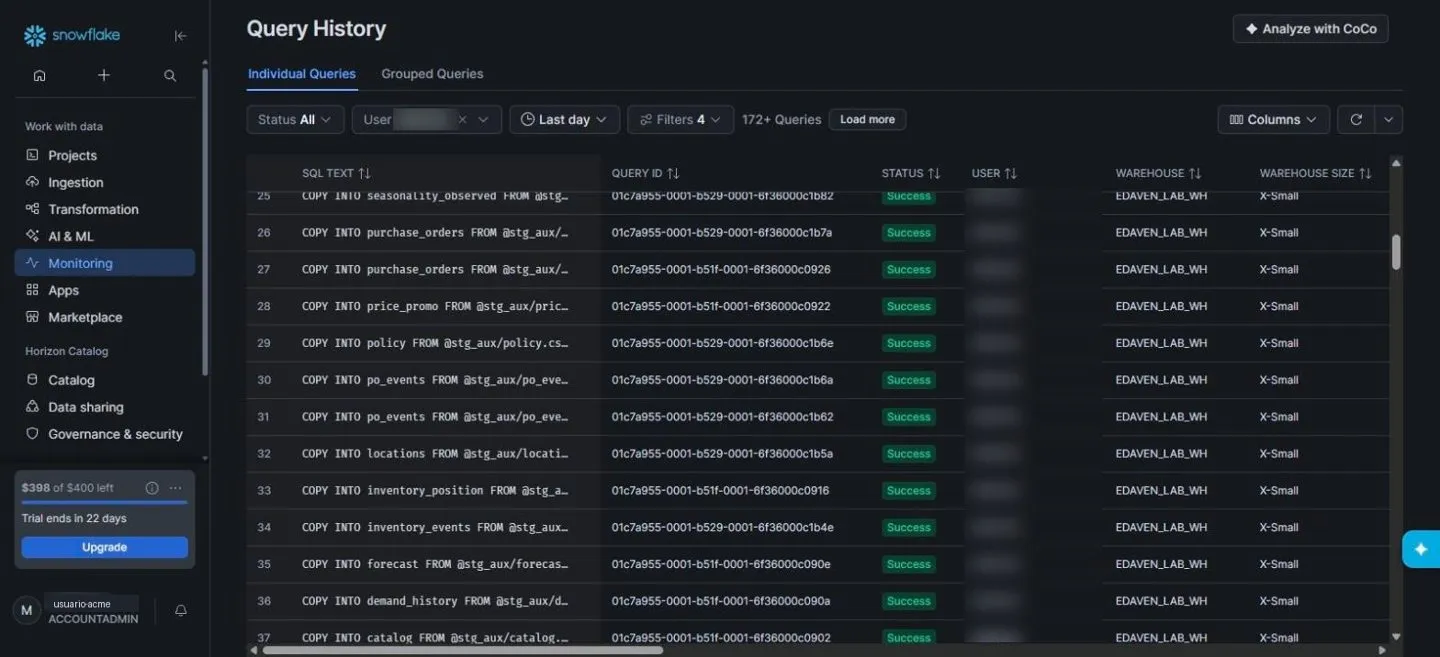
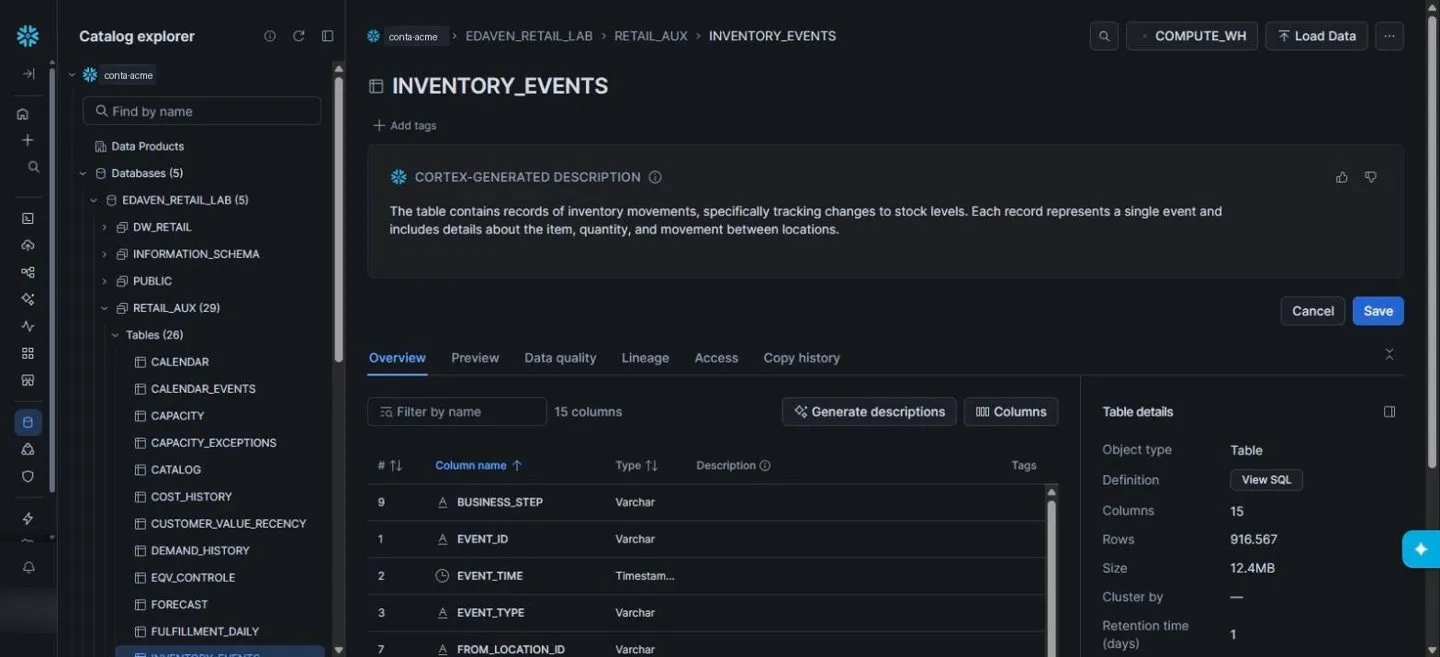
INVENTORY_EVENTS with 916,567 rows, the same as the source. The data is right. The context of how it got there was left out.Everything worked. The speed belonged to the agent, not to the organisation
Technically, the load succeeded. Tracing would be possible, but as an investigation: piecing together query history, conversation and commits. At the end of the afternoon, Acme could not answer simple questions:
| Organisation’s question | Axis | Answer without EDAVEN |
|---|---|---|
| Who asked, and why? | Responsibility | In a conversation. Outside any company system. |
| Under what authority? | Authority | Account administrator role, with no scope or deadline. |
| Who reviewed? | Control | Nobody besides whoever executed. |
| What deviations happened? | Control | Remembered by whoever did it. No record tied to the execution. |
| Is it proven? | Responsibility | Yes, in a project file the audit cannot reach. |
| What did we learn? | Governance | In the head of whoever did it and in a commit. The next team starts from scratch. |
| What did it cost? | Governance | Platform credits show up on the invoice. The cost of the agent and the people does not. |
| Which decision did it serve? | Governance | No link to business value. |
with EDAVEN
With EDAVEN: architecture, engineering and operation
EDAVEN Organisation and Agents is the operating system of the organisation of people and agents. It is the hub where the company allocates teams of people and agents, grants models, defines mandates and keeps the fiduciary relationship, that is, who answers for what. Data and Decisions are the engines that connect the hub to the ecosystem, to consume and to deliver.
The models are the same as in the lab. What changes is that they come in through the hub. Jev, for example, is connected on screen as a decision provider: the organisation’s own key kept in the vault, recorded data-egress consent and enablement approved by a second person. It can run in shadow mode, only to calibrate, with calibration recorded per use case.
Architecture
A control plane above the platforms. The tools remain the company’s; governance becomes one.
Engineering
Every rule becomes a control applied before the act: mandate, authority, credential with scope and window, second person, receipt and proof.
Operation
People and agents work every day inside those controls, with owner, evidence, learning and cost visible.
Architecture: one contract per tool class
The hub treats the ecosystem by tool class, always with the same contract: describe what it can do, simulate, execute with a receipt, verify against the proof template and revert when possible. SQL platforms, versioned code and MCP servers have ports in the product. Orchestrators and BI, semantics and catalogue tools are connected by the implementation service, through the tool’s own API or MCP, under the same governance.
| Tool class | How the hub delivers | Typical proof |
|---|---|---|
| SQL data platform | Warehouse, lakehouse or database. Statements under the leased role, one per step, from the source declared in the envelope | Counts, control sums, schema preview |
| Versioned code | dbt, semantics as code, notebooks. Pull request in the customer’s repository, customer CI, merge as a human decision | Green CI, project tests, diff |
| Orchestrator | Connected by the implementation service. Triggers an already approved pipeline, with the envelope’s parameters | Final state and logs |
| BI, semantics and catalogue | Connected by the implementation service. Publishes through the tool’s API | Before and after, owner notified |
| MCP servers | Tool call under the lease’s token | Result plus verification probe |
Engineering: the same load, with the rule holding before every act
- Case. The request comes in as a case, with owner, purpose and deadline.
- Team. A data engineer and a data engineering agent, with the models granted by the organisation: the agent’s language model and, if it wants, Jev as decision provider.
- Mandate. Scope (database and schemas), allowed verbs and validity, accepted by name by whoever answers. Never the whole account.
- Plan with envelope. The agent proposes the plan. The person approves the whole envelope once: scope, data source, verbs, cost limit, window and proof template. The second person comes in where the risk calls for it.
- Leased credential. A delivery role with scope and window, activated for that execution and deactivated at the end; if the window is exceeded, the hub alerts and records it. No administrator.
- Execution with receipt. Every step generates a receipt with the exact SQL and the identifier returned by the platform. A deviation, such as splitting a file, becomes a new plan version with a reason.
- Proof against the template. The 152 counts and the 707 controls enter as evidence in the organisation’s ledger, tamper-evident.
- Learning and cost. The
NUMERICdefect becomes a candidate for the organisation’s memory, with human curation. Cost closes per plan: agents running on EDAVEN are measured; the platform is measured when it reports, or estimated with a declared basis; people’s time is declared. And it links to the value of the decision that uses this data.
Operation: how it shows up in the product
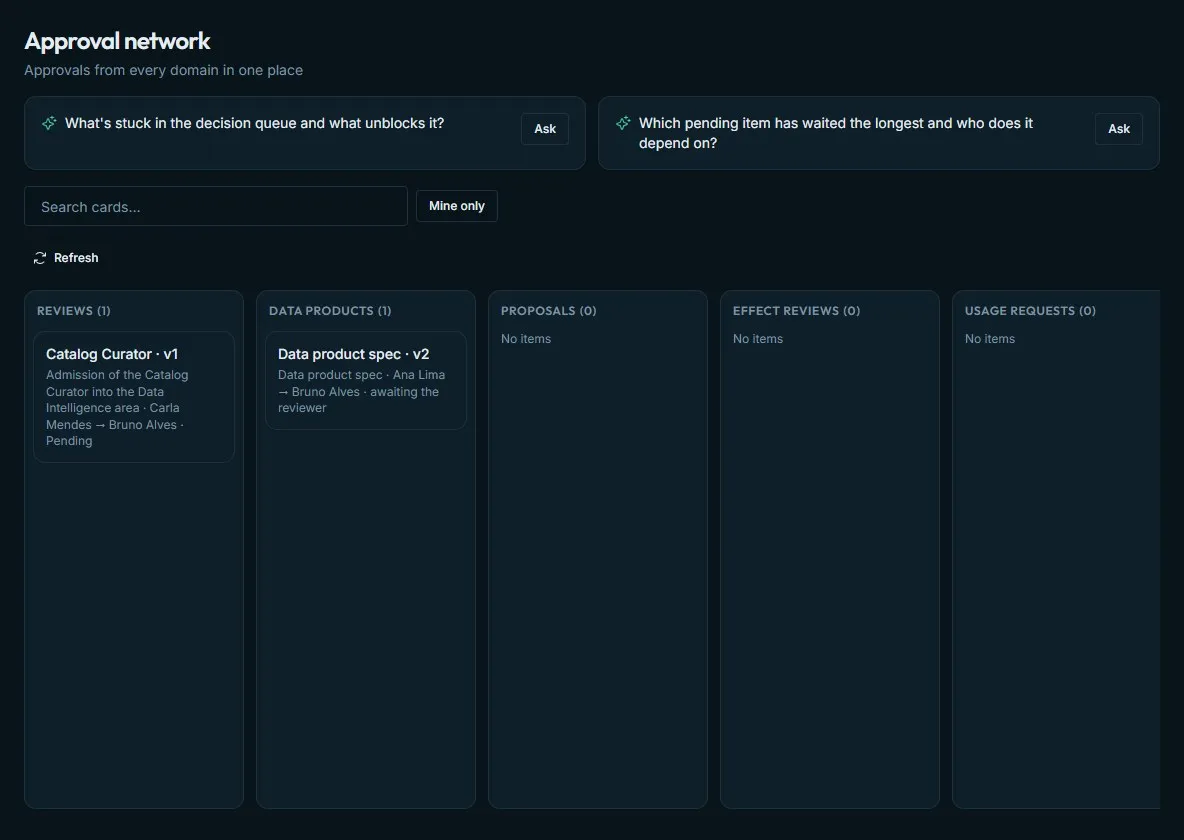
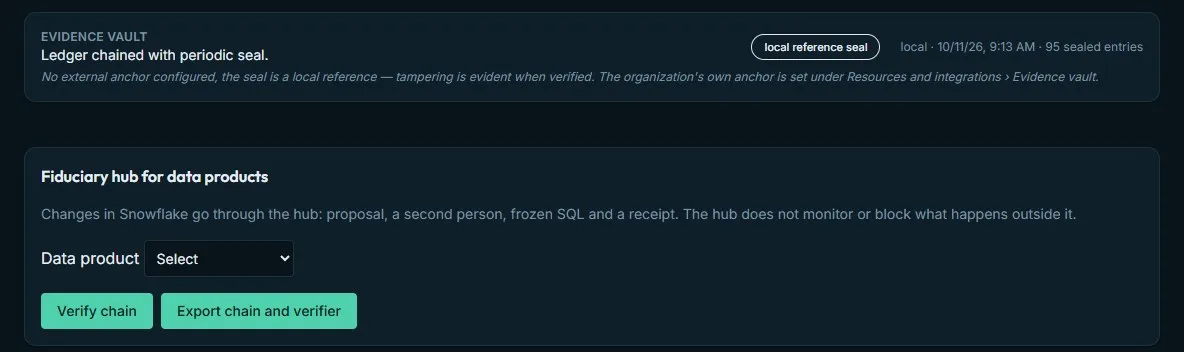
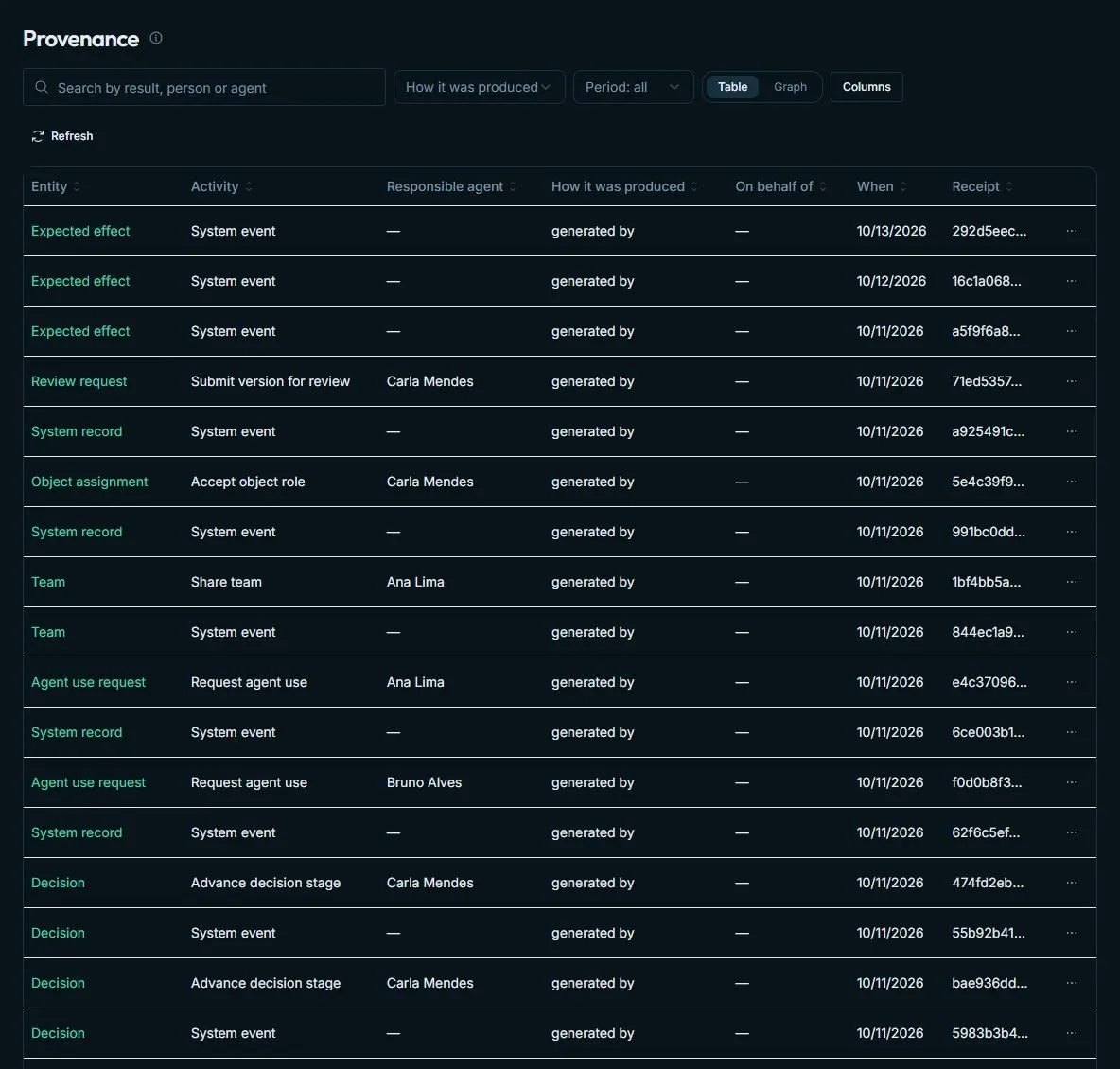
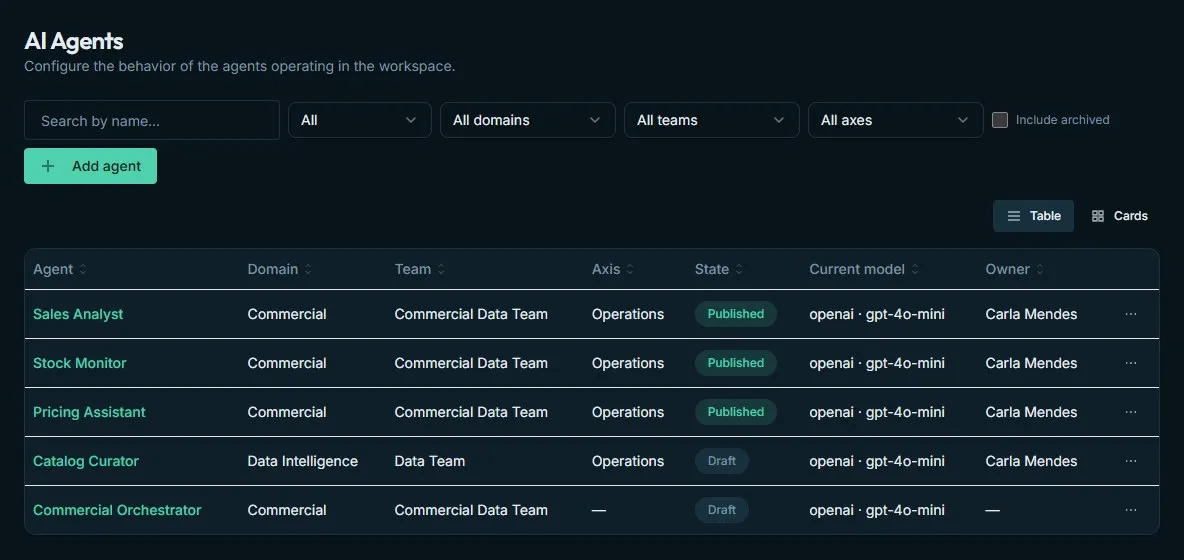
The screens below are from EDAVEN in synthetic operation: the real product, in a demo tenant with Acme’s synthetic people, agents and data.
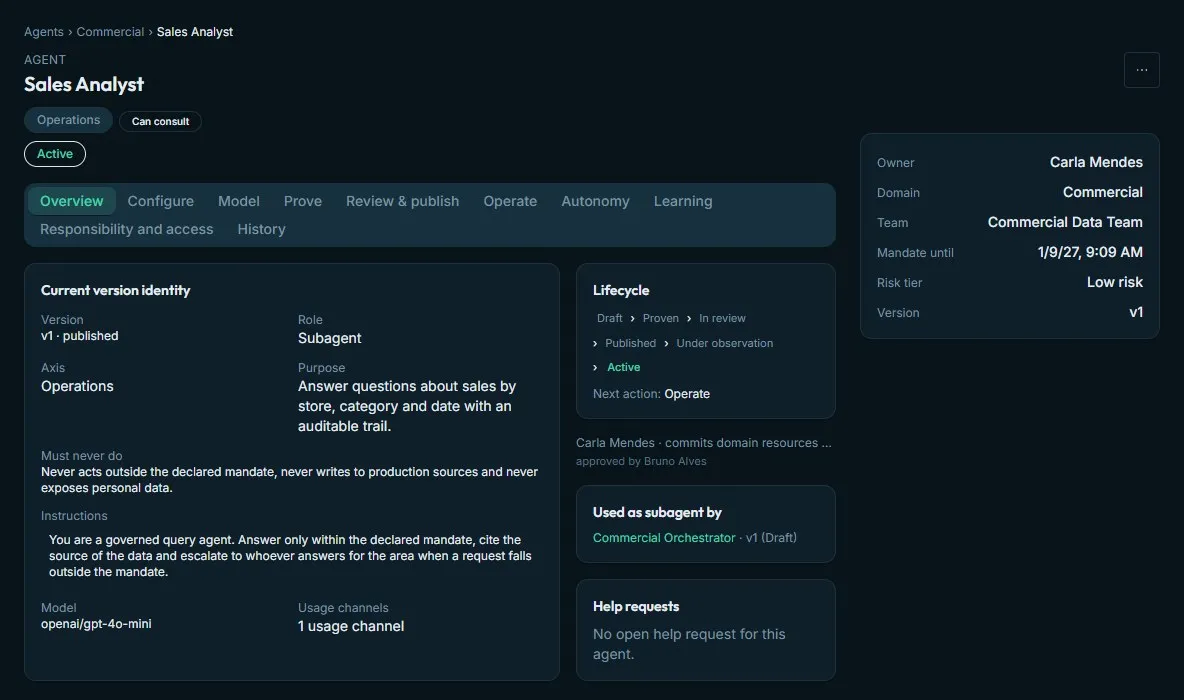
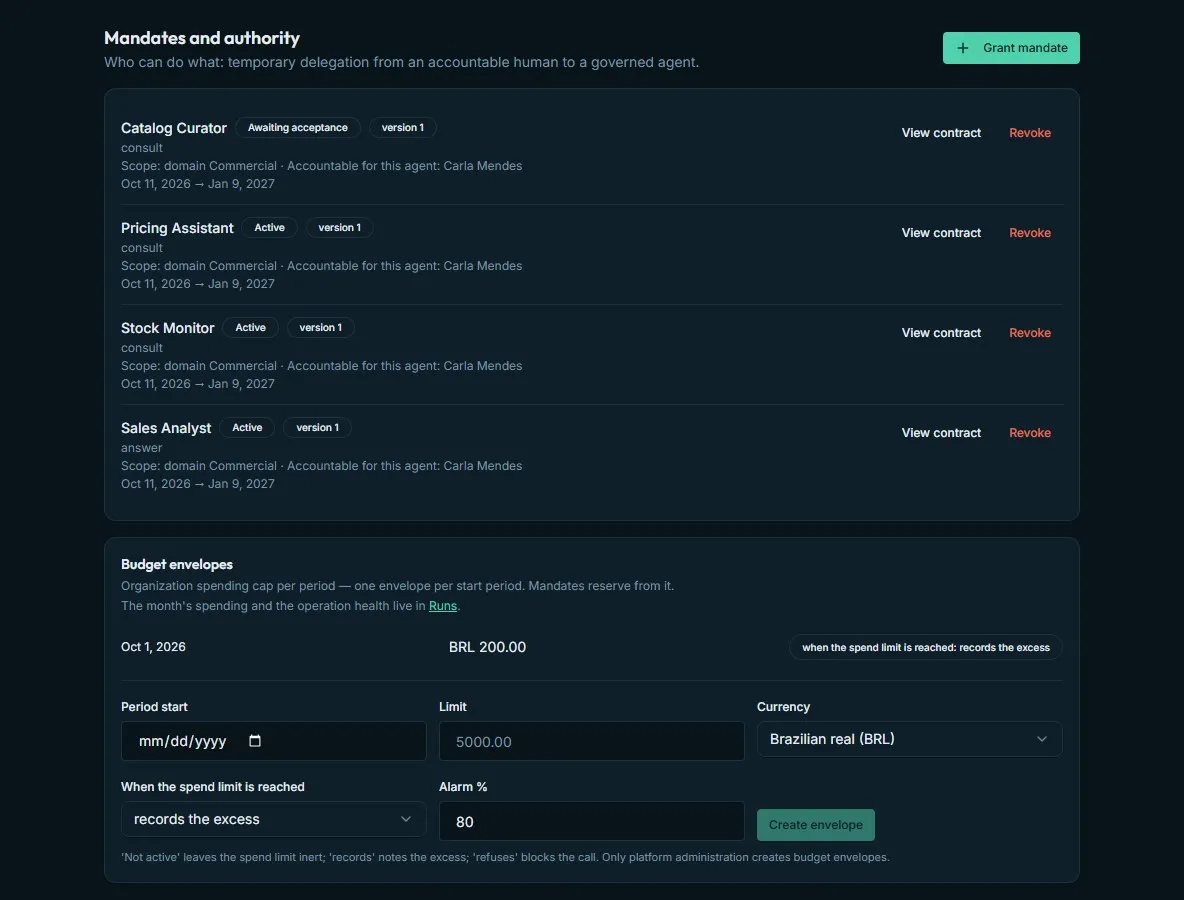
Authority, responsibility and control, before the act
| Axis | Without EDAVEN | With EDAVEN |
|---|---|---|
| Authority | The agent acted with the account’s full power | Mandate accepted by name, with scope, verbs, budget and validity |
| Responsibility | Whoever had the administrator password did it; the proof sat in a project file | Every act with an owner and a receipt. A context pack only feeds the decision once admitted: origin and integrity checked, within its validity and under an active mandate. The load is proven against the template |
| Control | Files loaded and fixed by hand, with no review by another person | Plan approved once, authority applied, credential with scope and window, a second person where the risk calls for it |
| Dimension | Without EDAVEN | With EDAVEN |
|---|---|---|
| Credential | Account administrator | Leased delivery role, with scope and window |
| Authority | Implicit | Mandate with scope, verbs and validity |
| Review | Whoever did it reviewed it | A second person by risk tier, never self-approval |
| Deviations | Decided on the spot, unrecorded | New plan version or proposal with a reason |
| Proof | Project file | Proof template per type of work, evidence in the ledger |
| Learning | Personal | Organisation memory and skill, with curation |
| Cost | Platform invoice | Per plan, with a limit: EDAVEN agents measured, platform measured or estimated, people declared |
| Value | No link | Linked to the decision that uses the data, with expected and observed effect |
What the market points to
Gartner puts ready data, governance and value on AI’s critical path. The forecasts below come from the data, analytics and AI predictions report through 2031 and from the data readiness study.
“Without AI-ready data, the promise of AI will fail to materialize.”
Gartner, Over 100 Data, Analytics and AI Predictions Through 2031
of data leaders say their data engineering practices are very effective for current AI use cases. Only 10% deliver within the agreed time.
Gartner, Data readiness is a top barrier to AIof data leaders say the architecture needs revision to support new use cases.
Gartner, Data readiness is a top barrier to AIof business decisions augmented or automated by AI agents by 2027.
Gartner, Predicts 2025: AI-Powered Analyticsof business decisions made semi-autonomously or autonomously with agents by 2028, up from less than 1% today.
Gartner, Predicts 2025: AI and the Future of Workof enterprise breaches traced to AI agent abuse by 2028.
Gartner, Predicts 2025: AI’s Impact on the Future of Enterprise Technologyof large enterprises adopting FinOps for AI by 2027, due to cost and budget miscalculations.
Gartner, Predicts 2025: AI’s Impact on the Future of Enterprise TechnologyThe gains for the company
Data engineering that delivers on time, under control
Teams of people and agents work inside an envelope approved once, without waiting for approval on every statement. The agents’ speed starts to count for the whole organisation.
Answers the 26% and 10% from the data readiness study.
Agents without an administrator credential
A leased credential, with scope and window, and a mandate with an owner. Through the hub, the agent does only what the mandate allows.
Answers the forecast of 25% of breaches from agent abuse by 2028.
Automated decisions that explain themselves
Every decision an agent supports carries the trail of the data behind it: who loaded it, with what proof, with what review.
Answers the 50% and the 1/3 of decisions with agents.
AI cost visible and limited
Cost of agents running on EDAVEN measured; platform cost measured when it reports, or estimated and labelled as an estimate; people’s time declared. All per plan, with a limit in the envelope and a link to the decision’s value.
Answers FinOps for AI adoption by 60% of large enterprises by 2027.
Learning stays in the company
Deviations and fixes become the organisation’s memory and skill, with curation. The next team does not repeat the defect, and the knowledge stays with the company if it changes model or vendor.
According to Gartner, 40% of organisations will revive knowledge management by 2027.
One governance for the whole ecosystem
The same hub governs warehouse, dbt, orchestrator, BI and MCP servers. The company picks the tools, and governance stays one.
By 2028, 80% of GenAI applications will be built on the data platforms companies already have (Gartner).
And with hundreds of agents?
The lab has one engineer and one agent. An organisation has dozens of people, hundreds of agents, several domains and more than one business unit. The right question is not whether everything can be traced. Tracing everything is easy. The hard part is deciding, act by act, whether it needs a person.
EDAVEN was designed so that human attention grows with risk, not with volume.
Approve plans, not statements
The person approves a job’s envelope once: scope, verbs, data source, cost limit and expected proof. Inside it, the steps proceed with receipts. Outside it, they become proposals. A hundred statements in a load are one human decision, not a hundred.
Autonomy earned, and lost, through evidence
Every act has a consequence class: read-only, proposes a change, changes state or has an external effect. An agent’s autonomy on each action rises when a person grants it on the evidence of the agent’s own work, computed by the system, and drops on its own when the sample worsens or when the agent goes beyond the envelope. The more the agent proves, the less it interrupts, and never by its own decision.
Each owner sees what is theirs
The organisation is split into domains and teams with an owner and a mandate, and business people act within their teams’ domains. Each person has their own queue, with the reviews, help requests and responsibilities that need them. Each owner receives a weekly summary of the agents, connectors and teams they are responsible for, with usage, cost, impact, risks and pending releases. The observatory shows the organisation through four separate lenses: usage, cost, impact and risk.
Agents that coordinate agents gain no power
When an agent delegates to another, both need a mandate: the delegator, to delegate; the receiver, to act. Delegation confers no authority, it only uses the authority each already has, and each side answers in its own receipt. Delegating to an outside agent also goes through the data class, the mandate budget and an accountable person in the chain.
Proof keeps up with volume
Every act produces a receipt. Receipts enter a chained ledger, with a periodic seal that can carry a timestamp from an external authority, checked outside the database. Auditing a thousand acts means verifying one chain, not reading a thousand records.
Many units, one governance
An organisation with several business units or countries defines its policies once. Each unit runs its domains, agents and data with local autonomy and inherits what the organisation decided. Leadership sees the consolidated view, and one unit’s data does not cross to another without an agreement.
What measures an operation at scale
Scale of people and agents is not proven by the number of agents. It is proven by these indicators:
- review hours per person per week;
- share of acts that stay within autonomy and share that goes up to a person;
- time until a pending item reaches whoever decides;
- acts outside the envelope and autonomy demotions;
- time to verify the proof chain.
These are the numbers a governed operation tracks, by domain and by unit.
Architecture alone is not enough
Designing where the controls sit is necessary. But the three rules only hold when a system applies them before every act, on any platform, every day. That does not fit in a slide or a project. It fits in a sociotechnical operating system: people and agents as one organisation, with central engineering and operation above all platforms. Governance, then, is not a brake: it is what lets the organisation delegate more, to more agents, on more platforms.
In your operation, do agents act with delegated authority, or with the access of whoever opened the console? Talk to us: matias.rein@arcogi.com.
Sources
- Gartner, Over 100 Data, Analytics and AI Predictions Through 2031 (Gartner for IT Leaders; S. James, A. D. Duncan). Includes Predicts 2025: AI-Powered Analytics; AI and the Future of Work; AI’s Impact on the Future of Enterprise Technology; 4 Ways AI Will Disrupt Data Management Markets and Solutions; and the core D&A predictions.
- Gartner, Data readiness is a top barrier to AI, infographic, 2026 (CTMKT_5078150).
- Acme lab, 11 October 2026: 152 tables, 4,481,165 rows, 707 equivalence controls between Postgres and Snowflake.